
Cooling Tower: best practices for efficient water treatment with Dropson EMI technology
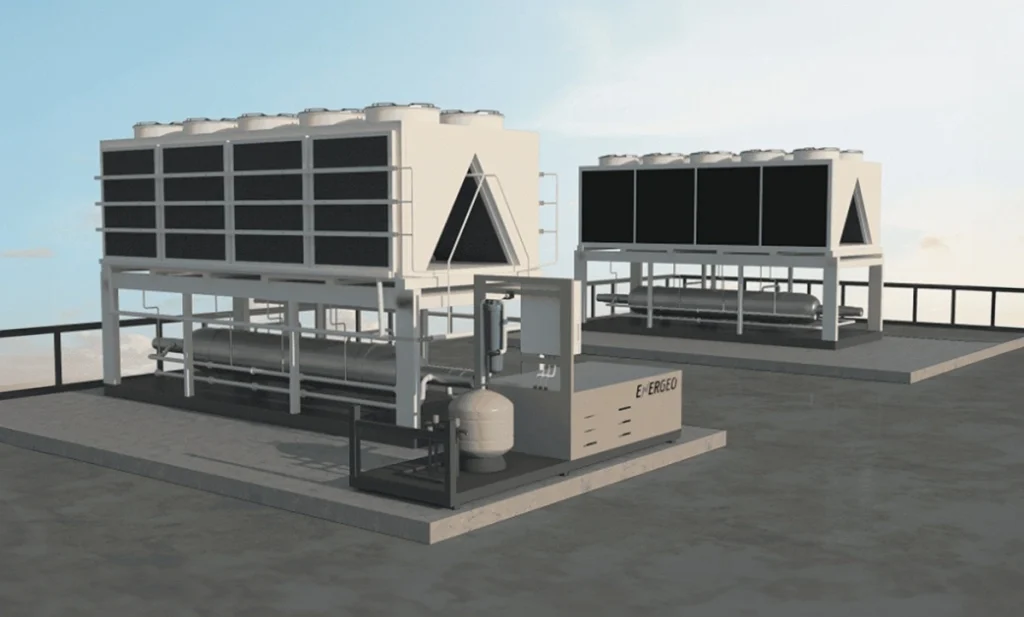
Industrial cooling towers are essential in numerous sectors, such as manufacturing, power generation, and the climate control of large infrastructures. Their primary function is to dissipate heat generated in industrial processes through a water circuit that transports thermal energy from the equipment to the tower, where it is cooled by heat exchange with the air. However, this process entails a series of technical challenges related to water quality, including scale accumulation, biofilm formation, and the growth of microorganisms like Legionella.
Water treatment in these systems is fundamental to ensure efficient and safe operation. Traditionally, chemical products have been used to control scale and bacteria, but these treatments have high costs and a significant environmental impact. Dropson’s EMI (Electromagnetic Impact) technology offers an innovative alternative that reduces calcareous deposits, minimizes biofilm formation, and improves water quality without replacing mandatory maintenance and bacteriological control protocols. This report explores how installing the Dropson EMI system in cooling towers can optimize their performance, reduce operating costs, and enhance safety without interfering with current regulations.
1. Operation of an Industrial Cooling Tower
1.1 Basic Concepts
A cooling tower is a heat dissipation system that extracts heat from a water circuit through heat exchange with the air, allowing for the cooling of industrial machinery, HVAC systems, or production processes. Its operation is based on the partial evaporation of water, which removes residual heat and reduces the liquid’s temperature before it returns to the circuit.
Different types of cooling towers exist, including forced draft, induced draft, and closed-circuit towers, each with specific characteristics depending on the industrial application. However, they all share the same principle: hot water arrives from the machinery to the tower’s distribution system, where it is sprayed and exposed to airflow to cool down before being recirculated. This cycle repeats constantly, creating water quality challenges due to evaporation, salt concentration, and contaminant accumulation.
1.2 Main Technical Components
To understand how Dropson EMI treatment integrates into a cooling tower, it’s necessary to know the system’s main components:
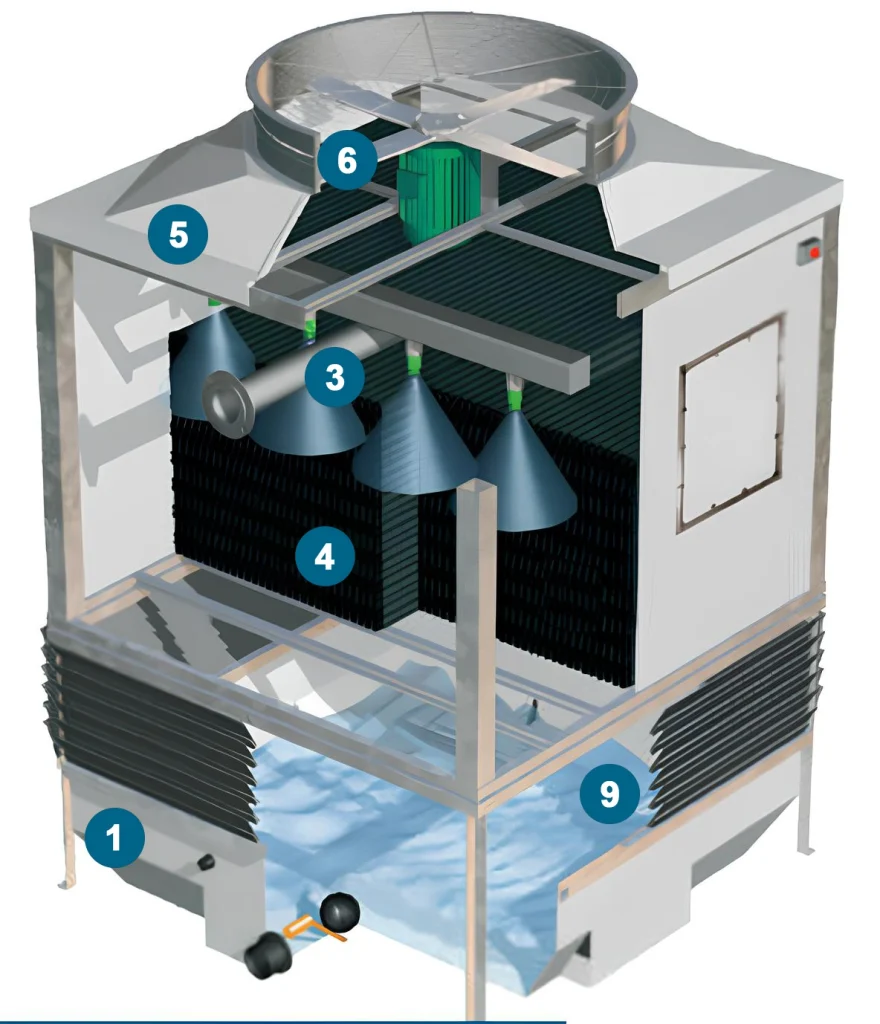
- Tower Water Basin (Sump or Accumulation Tank) (1): This is the reservoir where cold water is stored before being pumped back into the system. At this point, the water has already been cooled after heat exchange and is ready to recirculate.
- Recirculation Pump (2): Draws water from the sump and propels it through the circuit to be used in the cooling system. Its flow rate capacity is a key factor for the water treatment strategy.
- Water Distribution Circuit (3): Includes pipes, nozzles, and distribution trays that allow water to be spread in the tower to maximize contact with air and thermal dissipation.
- Heat Exchange Zone (4): In this area, hot water from the industrial system is distributed as droplets or a thin film over a fill material, known as fill pack. Simultaneously, an airflow passes through the tower in the opposite direction (counterflow) or in the same direction (co-current flow), promoting partial water evaporation.
- Evaporation and Heat Dissipation (5): Approximately 1-3% of the water evaporates in each cycle, allowing for the removal of latent heat and the cooling of the remaining water. The greater the contact surface between air and water, the higher the process efficiency.
- Air Draft (6): Can be forced (with fans at the base) or induced (fans at the top extracting hot air outwards). Airflow is key to the tower’s performance.
- Return Circuit (7): Transports hot water from the heat exchangers to the tower for cooling. This is the part of the system where water has the highest salt concentration and the greatest risk of calcareous deposits.
- Heat Exchanger (8): Can be plate, coil, or shell-and-tube type, and its function is to transfer heat from the industrial process to the recirculation water. Scale accumulation in these units reduces their efficiency and increases energy consumption.
- Blowdown System and Conductivity Sensors (9): Regulates water quality by removing a portion of the liquid when its concentration of salts and dissolved solids exceeds a certain threshold. This process is fundamental to prevent tower saturation with minerals that can generate deposits or favor microorganism growth.
2. Regulations and Safety in Cooling Towers
Industrial cooling towers must comply with strict safety and maintenance regulations due to the risk of bacterial proliferation, especially Legionella. In Europe and specific countries like Spain, there are specific regulations governing water quality, system cleaning, and the prevention of microbiological contamination. These regulations establish protocols for inspection, disinfection, and water blowdown to minimize health risks.
The use of Dropson’s EMI technology does not replace these protocols but acts as a complement to improve water quality, reduce biofilm, and decrease reliance on chemical products. Regulations such as Royal Decree 865/2003 in Spain or European Directive 2000/54/EC on biological agents establish the need for biocontamination control in cooling systems. Dropson contributes to this control by reducing the formation of calcareous deposits, which are an ideal medium for biofilm and bacteria development.
2.1 Key Points of Applicable Regulations
Cooling tower maintenance regulations establish:
- Periodic water quality controls, including measurements of conductivity, hardness, and bacterial presence.
- Mandatory cleaning and disinfection, with specific products to eliminate biofilm and microorganisms.
- Blowdown systems to prevent excessive concentrations of salts and residues.
- Mandatory records and documentation of maintenance actions.
Dropson does not replace these processes but helps optimize the system by reducing scale and biofilm, thereby minimizing the formation of environments conducive to microorganisms.
3. Relationship Between Scale, Biofilm, and Microorganism Development
Calcareous deposits not only affect the installation’s energy efficiency but also contribute to the proliferation of biofilm and microorganisms. Calcium carbonate acts as a physical support where bacteria can adhere and multiply, generating biofilm layers that are difficult to remove with conventional disinfectants.
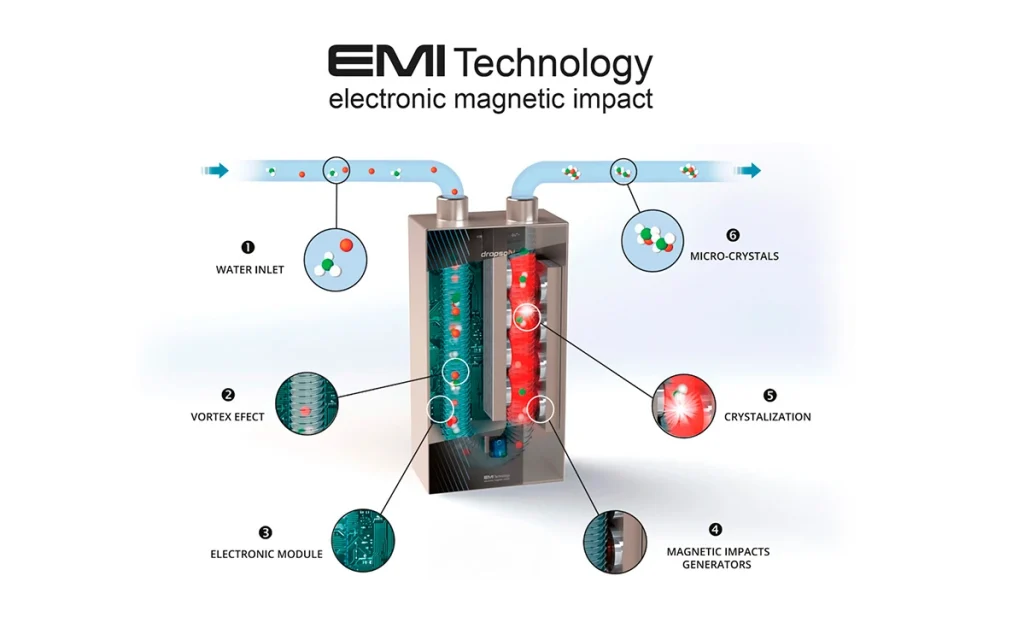
When a Dropson EMI system is installed, the dissolved calcium and carbonate in the water form suspended microcrystals that do not adhere to surfaces. This has a positive effect on biofilm reduction because:
- Rough surfaces where bacteria can lodge are eliminated.
- The lack of deposits reduces microorganism adhesion.
- Biofilm decreases, facilitating the work of biocides and reducing the need for chemical products.
By reducing deposit formation, the proliferation of bacteria like Legionella, which thrive in environments with biofilm, is indirectly limited. Thus, using Dropson in combination with proper maintenance contributes to a safer and more efficient installation.
4. Implementation of the Dropson EMI System in Bypass
Water treatment in cooling towers must be efficient without affecting system performance. For this reason, Dropson’s EMI technology is installed in bypass on the discharge side of the recirculation pump. This configuration allows a sufficient volume of water to be treated in each cycle without interfering with the system’s main flow.
4.1 Reason for Bypass Installation
Cooling tower water recirculates constantly. For example, if a tower has a 10 m³ accumulation tank and a 30 m³/h recirculation pump, it means the entire tank volume passes through the pump three times per hour. Installing a Dropson system in bypass means that only a part of the total flow will pass through the EMI unit in each cycle, but due to high recirculation, all the tower water will be treated multiple times within an hour, achieving a progressive and continuous effect.
4.2 Practical Installation Example
- Typical Capacities:
- 10 m³ basin
- 30 m³/h recirculation pump
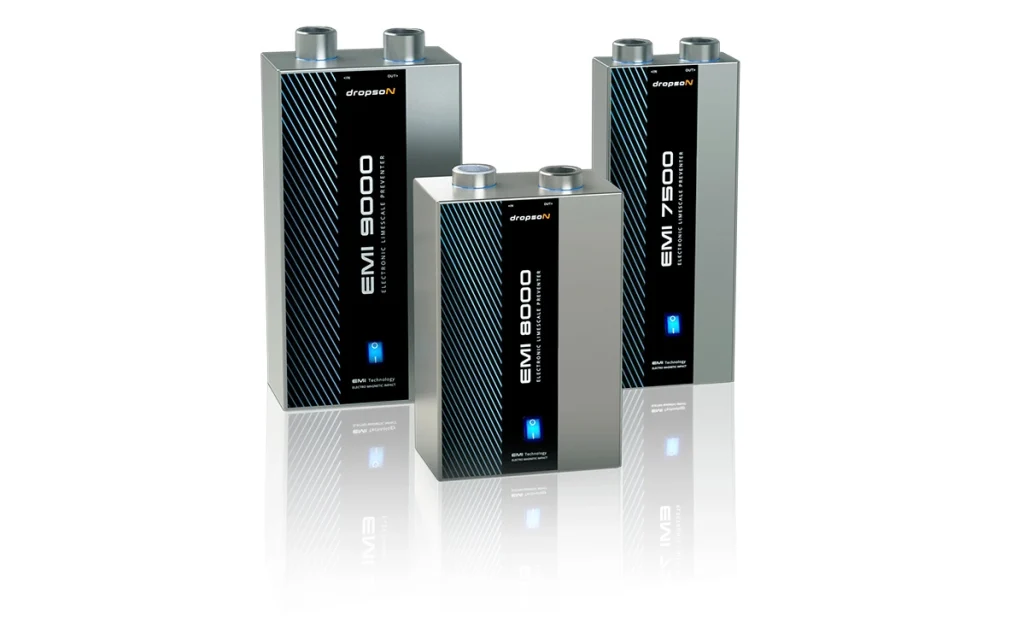
- Installation of a Dropson EMI 9000 with a capacity of 12 m³/h
- In one hour, the water will have passed through the Dropson EMI approximately once completely, ensuring homogeneous treatment.
- Location of the Dropson EMI Unit:
- Installed in bypass at the outlet of the recirculation pump, on the cold water discharge before it is sent to the system.
- Not installed on the hot water return, as treatment should be applied to already cooled water to prevent deposits in the heat exchanger and other sensitive components.
- Effect of EMI Treatment:
- The Dropson system converts dissolved minerals into calcium carbonate microcrystals in the form of aragonite, which do not adhere to surfaces.
- These microcrystals remain suspended in the water and can be removed through the blowdown system or via Dropson particle filters, which optimize circuit cleaning.
5. Complementing with Dropson Particle Filters
The calcium carbonate microcrystals generated by the EMI system should be evacuated to prevent their accumulation in the installation. Dropson particle filters capture these particles and purge them automatically, further reducing tower maintenance.
5.1 Elimination of Calcium Carbonate Microcrystals
The particle filter is installed in bypass, usually in the blowdown circuit or at a strategic point in the water return. Its operation is as follows:
- Captures the microcrystals generated by the EMI system before they accumulate in pipes or the heat exchanger.
- Automatic purge that periodically expels the microcrystals without manual intervention.
- Process visualization: The user can observe the quantity of particles eliminated, demonstrating the system’s effect.
5.2 Reduction of Water Consumption via Blowdown
Most cooling towers have a conductivity sensor that activates blowdown when the salt concentration in the water exceeds a certain limit. However, with the use of a Dropson particle filter:
- Part of the suspended solids are removed before the sensor detects an excess of salts.
- The water takes longer to reach the conductivity limit.
- Blowdown frequencies are reduced, saving water and lowering operating costs.
6. Impact on Biofilm and Microorganisms
The growth of biofilm and microorganisms in cooling towers is a critical problem, as it affects the system’s thermal efficiency and can be a focus of bacterial proliferation, including Legionella. Biofilm is a slimy layer of microorganisms adhered to surfaces, which forms more easily in the presence of calcareous deposits.
6.1 How EMI Technology Reduces Biofilm and Microorganisms
Dropson’s EMI system not only prevents scale formation but also has a positive impact on biofilm reduction for several reasons:
Elimination of Rough Surfaces:
- Scale accumulated in pipes and components creates an ideal environment for microorganisms to adhere and proliferate.
- By preventing calcareous deposits, Dropson reduces the surfaces where biofilm can develop, making bacterial adhesion difficult.
Interference in Microalgae Reproduction:
- In cooling towers, water exposed to air can favor microalgae growth.
- EMI technology affects the cell division mechanism of certain microalgae, slowing their growth without completely eliminating them.
- This results in less accumulation of organic matter, which in turn reduces the amount of nutrients available for bacteria like Legionella.
Improved Biocide Efficacy:
- Less biofilm means that disinfectant products act more efficiently, as bacteria are not protected within a calcareous or slimy layer.
- As a result, the installation may require fewer chemical products, optimizing costs and reducing environmental impact.
Contribution to Water Safety:
- While the EMI system does not replace mandatory biocide treatments, it does improve water quality, making microorganism control more effective and towers safer and easier to maintain.
7. Operational Benefits of EMI Technology in Cooling Towers
The use of Dropson’s EMI systems in industrial cooling towers provides a series of technical and economic benefits, improving system efficiency and reducing maintenance costs.
7.1 Reduction of Deposits in the Heat Exchanger
Calcareous deposits in heat exchangers are a serious problem, as they decrease thermal transfer and necessitate higher energy consumption to maintain the same cooling capacity. Thanks to EMI technology:
- Scale accumulation in heat exchangers is prevented, maintaining their optimal performance.
- Chemical cleaning interventions are reduced, extending the equipment’s lifespan.
- Energy consumption decreases, as the system operates with greater thermal efficiency.
7.2 Reduced System Maintenance and Cleaning
The reduction of scale and biofilm allows for:
- Less need for maintenance shutdowns, increasing the system’s operational availability.
- Fewer chemical products for cleaning and disinfection, reducing costs and environmental risks.
- Longer lifespan of components, preventing corrosion and blockages in pipes and nozzles.
7.3 Water Savings and Reduced Operating Costs
Using Dropson in combination with particle filters and efficient blowdown control allows for:
- Reduction in the amount of water eliminated in each blowdown cycle.
- Optimization of water consumption, lowering associated costs.
- Decrease in the cooling tower’s environmental impact, aligning with sustainability policies.
7.4 Contribution to Environmental Sustainability
Companies increasingly seek efficient and sustainable solutions, and Dropson’s EMI treatment helps reduce the use of chemical products, minimize water waste, and improve energy efficiency. This translates to:
- Smaller water footprint.
- Fewer chemical residues discharged into the environment.
- Greater energy efficiency, reducing the installation’s overall electricity consumption.
8. Conclusions and Recommendations
Industrial cooling towers are critical systems in multiple sectors, but their performance can be affected by problems such as calcareous deposit formation, biofilm and microorganism proliferation, and high water and energy consumption. To address these challenges, Dropson’s EMI technology presents itself as an innovative solution that improves operational efficiency without replacing mandatory maintenance and sanitary control protocols.
8.1 Summary of Key Benefits
Implementing Dropson’s EMI system in cooling towers offers multiple advantages:
- Prevention of Calcareous Deposits: Converts dissolved minerals into aragonite microcrystals, preventing deposits in pipes and heat exchangers.
- Reduction of Biofilm and Bacterial Proliferation: By minimizing scale accumulation, microorganism adhesion is hindered, improving biocide efficacy.
- Optimization of Water Consumption: The combination of EMI with particle filters allows for decreased blowdown frequency and water waste.
- Greater Energy Efficiency: A scale-free heat exchanger maintains its optimal thermal performance, reducing electricity consumption.
- Reduction of Operating Costs: Less corrective maintenance, lower use of chemical products, and reduced water and energy consumption.
- Environmental Sustainability: Decreases the water footprint and reliance on aggressive chemical treatments.
8.2 Recommendations for Implementation
To obtain maximum benefits from the EMI system in a cooling tower, it is recommended to:
- Install the system in bypass on the discharge side of the recirculation pump, ensuring continuous treatment of the entire water volume.
- Complement EMI treatment with Dropson particle filters to remove generated microcrystals and optimize circuit cleaning.
- Do not replace mandatory maintenance protocols but integrate them with EMI technology to improve water quality and reduce dependence on chemical products.
- Conduct periodic monitoring of the installation to verify improvements in water quality, thermal performance, and consumption savings.
8.3 Final Considerations
Using Dropson’s EMI system in cooling towers not only optimizes system operation and reduces costs but also enhances safety and environmental sustainability. By reducing scale and biofilm, it contributes to a cleaner and more efficient environment while maintaining compliance with sanitary regulations.
Companies seeking to improve the efficiency and sustainability of their installations can find an innovative, cost-effective solution in Dropson, compatible with the most demanding standards of the industrial sector.
Visit our website: www.dropson.com