
Solving the PUE vs WUE Paradox in Data Centers Without Chemicals
Solving the PUE vs WUE Paradox in Data Centers Without Chemicals
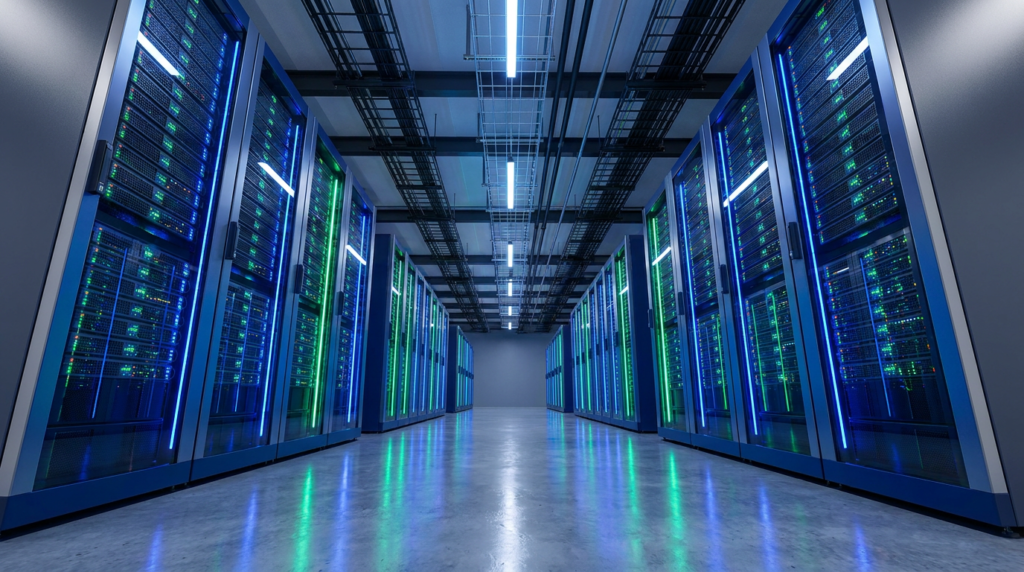
AI and High-Performance Computing (HPC) are pushing global thermal infrastructure to its absolute limits. This unprecedented demand creates a critical operational conflict, commonly known as the PUE vs WUE paradox, forcing facilities to choose between energy and water efficiency. High-density workloads drive the need for massive evaporative cooling systems to dissipate heat. However, facility managers face a relentless challenge: saving water ruins equipment via scaling, while saving equipment wastes water and requires toxic chemicals. S&P Global Ratings projections on critical infrastructure highlight that meeting strict ESG goals is no longer optional for the industry. The definitive solution lies in combining electromagnetic physical water treatment (Dropson
EMI) and advanced filtration (Microguard). This chemical-free synergy maximizes Cycles of Concentration (CoC) without thermodynamic or environmental penalties, resolving the engineering dilemma once and for all.
The Engineering Conflict: Thermal vs. Water Efficiency
Evaporative cooling relies on the latent heat of vaporization to dissipate massive thermal loads. However, this process has a fundamental physical flaw. Only pure water evaporates, leaving all dissolved minerals behind to concentrate in the recirculating water. This dynamic causes exponential mineral concentration over time, threatening the entire cooling ecosystem.
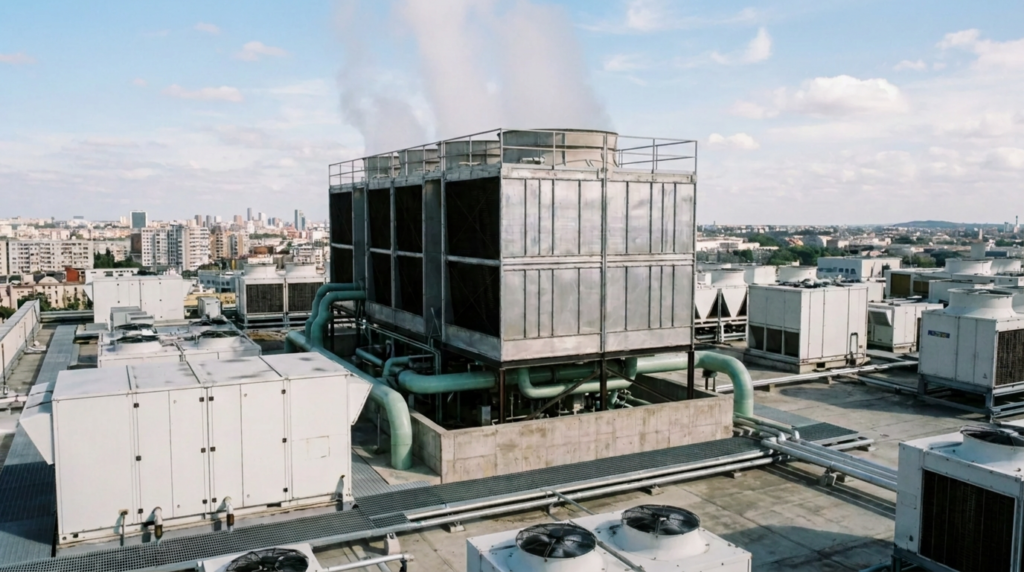
The Dilemma of Cycles of Concentration
Reducing make-up water is the only way to improve Water Usage Effectiveness (WUE). Engineers achieve this by increasing Cycles of Concentration (CoC) and minimizing blowdown volume. However, pushing water chemistry too far has severe consequences.
Pushing CoC leads to a highly positive Langelier Saturation Index (LSI). Exceeding solubility limits causes excess calcium (Ca²⁺) and carbonate (CO₃²⁻) ions to precipitate in high thermal stress areas, such as cooling tower fill packs and chiller tube bundles. This precipitate forms calcite (CaCO₃), a dense crystal with extremely low thermal conductivity that acts as a powerful, unintentional insulator.
The Limits of Traditional Chemicals and ESG Impact
To manage supersaturation, the industry historically relies on continuous chemical injection. Facilities use scale inhibitors like phosphonates and polyacrylates, alongside pH reducers, to force mineral solubility artificially.
However, chemical conditioning has critical structural flaws that compromise modern data center operations.
- Fouling Risk: Thermal load variations cause inevitable micro-scaling, degrading PUE over time despite continuous chemical dosing.
- CAPEX Corrosion: Long-term use of acids and oxidizing biocides destroys metal passivation, causing premature corrosion in stainless steel, copper, and galvanized steel.
- ESG Penalty: Blowdown water becomes highly toxic effluent, directly conflicting with global Zero Liquid Discharge (ZLD) corporate mandates.
Dropson EMI: Mastering Crystallization Kinetics
The solution requires manipulating fluid physics, not adding synthetic chemicals. Dropson EMI (Electro Magnetic Impact) uses advanced fluid physics to alter the polymorphic structure of calcium carbonate before it ever reaches hot heat exchange surfaces.
Internal Hydrodynamics and the Vortex Effect
Clamp-on passive magnetic systems fail in industrial settings because they cannot treat the entire water flow in laminar regimes. Incomplete flow interaction renders legacy magnetic water softeners completely ineffective.
Dropson utilizes an industrial-grade stainless steel active treatment cell. Its internal geometry induces a severe vortex, converting laminar flow to turbulent flow. This turbulence breaks hydrodynamic boundary layers, ensuring 100% of the water mass and dissolved ions pass directly through maximum intensity electromagnetic focal zones.
Multi-Frequency Electromagnetic Impacts
The electronic core bombards the high-vorticity fluid with multi-frequency electromagnetic impacts. This dynamic spectrum of EMI technology sharply contrasts with static frequency magnets, which lose their efficacy based on flow rate variations.
This electromagnetic induction supplies the necessary thermodynamic activation energy. It alters the surface charges of natural colloids, prepping the liquid for an immediate phase change and destabilizing dissolved calcareous salts.
From Heterogeneous to Homogeneous Nucleation
Conventional scaling relies on heterogeneous nucleation. Ions precipitate on the rough metal walls of hot condensers, forming sticky rhombohedral calcite crystals that choke the system.
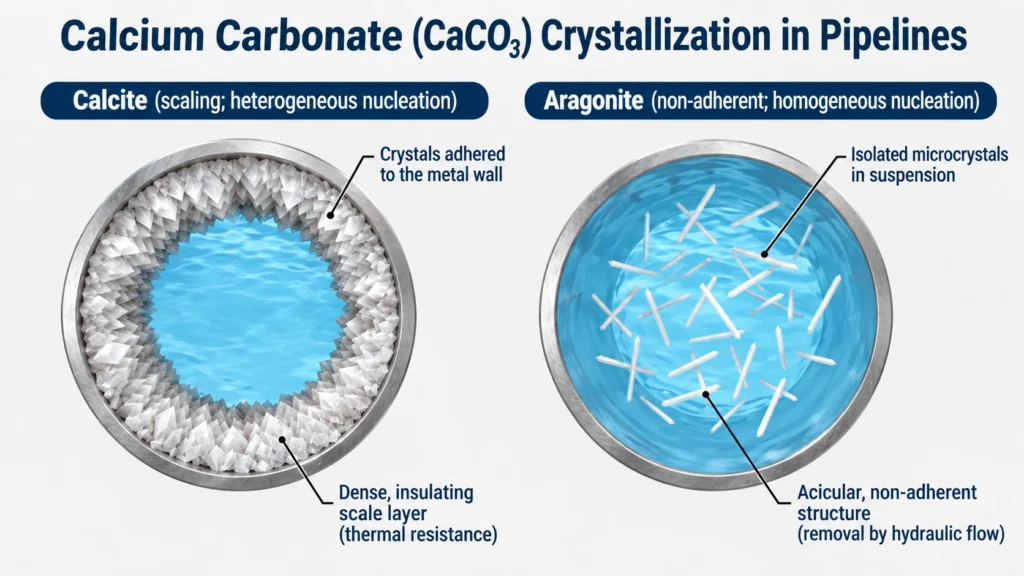
Dropson EMI reverses this kinetic process by forcing homogeneous nucleation. Accelerated ionic collisions force calcium carbonate to crystallize directly in the aqueous phase, long before touching any heat exchange surfaces.
The resulting polymorph is aragonite, featuring an orthorhombic or acicular symmetry. These form as millions of suspended microscopic colloids. Because of their saturated peripheral valence bonds and lack of free electrostatic charge, they are completely inert. They cannot stick to chiller tubes or cooling tower fills, ensuring pristine heat transfer surfaces.
Curative Dynamics and Microguard Synergy
Preventing new scale is only step one, as legacy systems often harbor hidden historical scale. The combined physical architecture offers an intrinsic curative behavior that cleans old, fouled systems without requiring downtime.
Descaling via Le Chatelier’s Principle
As electromagnetic treatment continuously converts free calcium ions into stable colloids, the dissolved hardness in the liquid phase drops significantly.
The fluid becomes relatively unsaturated compared to the existing scale. According to Le Chatelier’s Principle, the system seeks to restore calcium-carbonic equilibrium. This unsaturated water slowly and relentlessly dissolves the chemical bonds of historical calcite crusts.
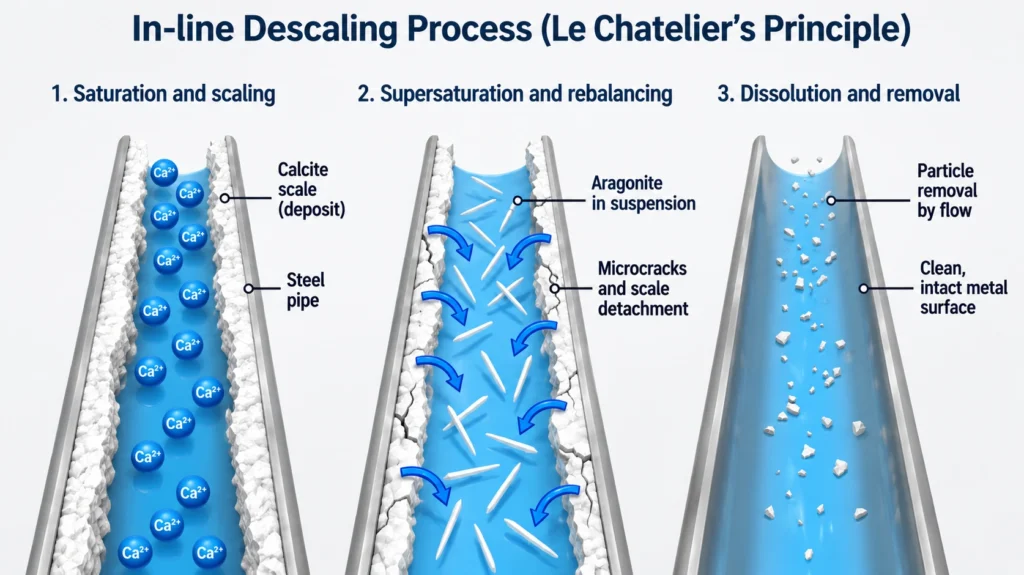
Old scale structurally weakens, softens, and gradually detaches into the main flow. This online descaling process avoids violent technical shutdowns and the high corrosion risks associated with harsh hydrochloric acid (HCl) washes.
Suspended Solids and Physical Evacuation
Both new aragonite colloids and detached historical scale become a massive load of suspended solids. A temporary increase in water turbidity during the first few months is normal physical evidence of the system actively purging the heat exchangers.
If not evacuated, this solid matter will settle in tower basins due to gravity, not thermal crystallization. Microguard advanced filtration serves as the mandatory mechanical extraction vector to remove these solids before they settle.
- Automated Blowdown: Extremely light aragonite microcrystals remain dispersed in the water column, allowing a large fraction to be expelled harmlessly during routine conductivity-based blowdowns.
- Microguard Backwashes: The filter continuously intercepts and agglomerates microcrystals, old scale, and airborne pollution like dust and pollen. Upon reaching a pressure differential or timer limit, it performs an automatic backwash, mechanically expelling retained matter to the drain.
Biological Substrate Mitigation and Legionella Control
There is a dangerous symbiotic relationship between biofilm and scale. The microporous structure of scale acts as a physical and thermal shield, protecting severe pathogens like Legionella pneumophila from biocides.
Eradicating scale and keeping the system sludge-free destroys the bacteria’s biological refuge. Water circulating over bare metal exposes planktonic growth. This allows mandatory biocide treatments to achieve maximum lethality at significantly lower chemical concentrations, ensuring strict biosecurity.
Engineering Metrics and Resource Consumption
Transitioning to a chemical-free physical architecture directly reflects on critical Operation and Maintenance (O&M) metrics.
Preserving the U-Coefficient and Maximizing COP/EER
Embedded calcium carbonate is an excellent unintentional thermal insulator. ASHRAE data and academic studies (Qureshi & Zubair, 2014) prove that just 1/16 of an inch (1.5 mm) of calcite scale drops heat exchange efficiency by 40%.
Condenser Approach Temperature is the thermal difference between condensed refrigerant temperature and tower water leaving temperature. Any increase in Approach Temperature directly indicates fouling in chillers.
Preventing scale preserves the Approach Temperature at unalterable design values, typically 1.5°F to 2.0°F. This prevents condensing pressure from rising, saving the compressor from chronic electromechanical overexertion. Clean condensers maximize COP (Coefficient of Performance) and EER (Energy Efficiency Ratio), directly reducing chiller electrical consumption by 10% to 15% and drastically improving total PUE.
Make-up Water Reduction and WUE Optimization
Without the fear of uncontrolled thermal precipitation, engineers can push water to its chemical limits. Evaporative systems can operate safely at severely positive Langelier Saturation Indexes (LSI).
Cycles of Concentration (CoC) can be elevated far beyond standard chemical program limits. Evaporating the same amount of water while radically restricting blowdown valves causes municipal make-up water demand to plummet. This is the only validated mechanical path to push Water Usage Effectiveness (WUE) to its absolute minimum without compromising cooling.
Comparative Analysis: Chemicals vs. Physical Synergy
Profitability Analysis and ROI
The profitability model offers a dual financial benefit for Facility Managers: defending physical assets long-term and immediately shrinking variable costs.
Extending Equipment Lifespan
Evaporative condensers and chiller tube bundles suffer severe metallurgical wear, such as passivation loss and pitting, after every reactive hydrochloric acid cleaning. Furthermore, the massive weight of sedimented calcite inside a cooling tower’s plastic fill pack can cause mechanical collapse, forcing extremely expensive replacements.
The physical architecture prevents this thermal and mechanical collapse. By eliminating cleaning acids and keeping the fill pack lightweight, the Data Center protects the highest CAPEX components in the cooling ecosystem.
Eliminating Consumables, Discharges, and Downtime
From an OPEX perspective, benefits are continuous. The system pays for itself in record time due to the synergistic sum of multiple savings.
- Monthly energy bills are slashed by shielding the refrigeration compressor’s isentropic efficiency.
- Make-up water consumption and sewage/wastewater bills plummet.
- The annual budget for purchasing chemical inhibitors, their logistics, and dosing pump maintenance is absolutely eradicated.
- Downtime and labor costs associated with reactive corrective cleanings due to high condensing pressure alerts during summer peaks are mitigated.
Implementing this advanced physical water treatment strategy transforms cooling infrastructure from a chemical-dependent liability into a self-sustaining, high-performance asset.
Future-Proofing Data Center Infrastructure
Achieving optimal PUE and WUE simultaneously is no longer an engineering paradox. By replacing outdated chemical treatments with the Dropson EMI and Microguard synergy, data centers can eliminate scale build-up, protect their CAPEX, and drastically reduce OPEX. This chemical-free approach ensures strict ESG compliance and Zero Liquid Discharge (ZLD) alignment, proving that the future of high-density cooling relies on advanced fluid physics, not toxic consumables.